


Instruments DTS
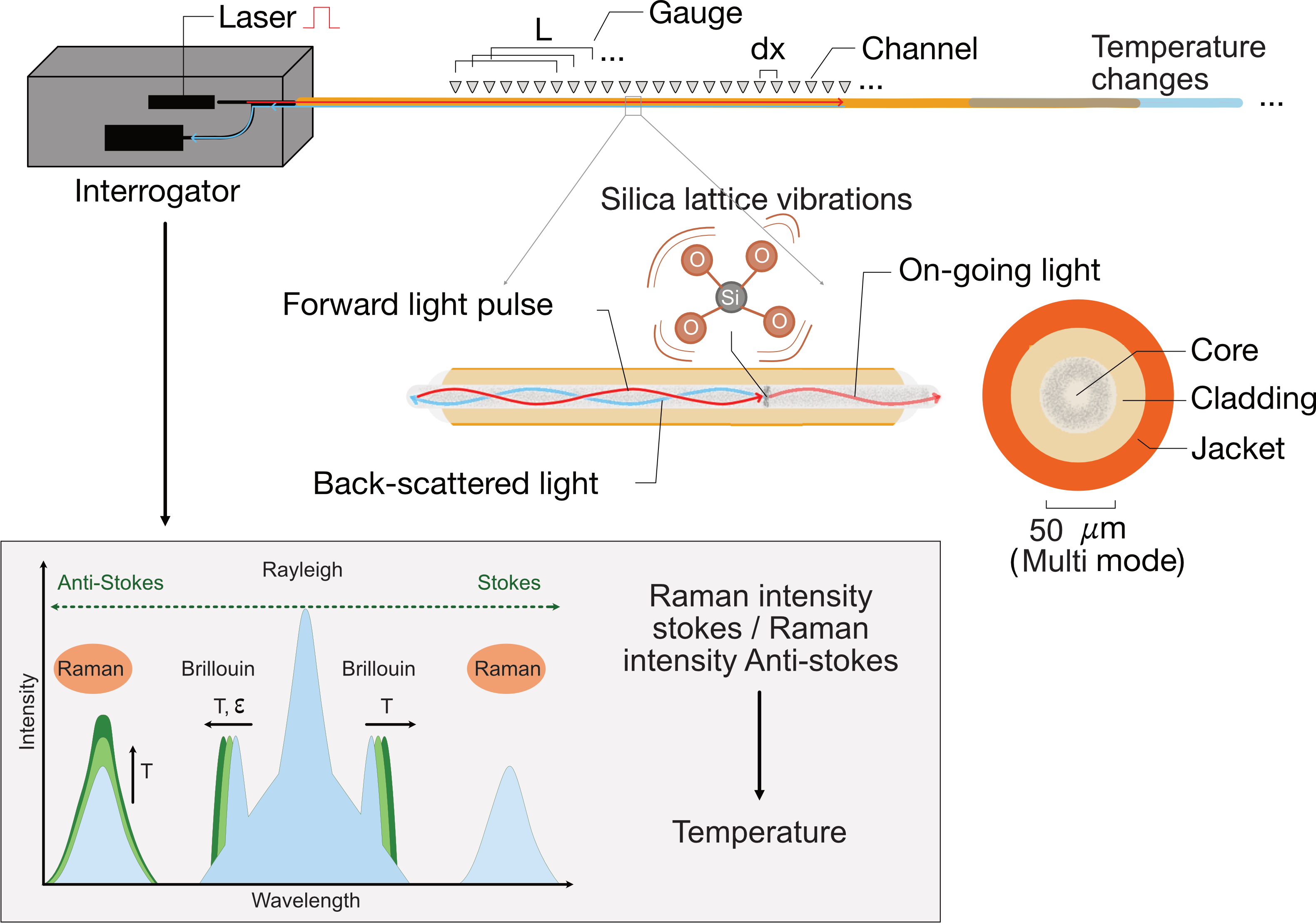
Figure 1: DTS measurement principle. Figure adapted from [1]
Raman scattering is another type of inelastic scattering, in which photons exchange energy with the optical phonons of the silica lattice via the thermal vibrations of the Si–O bonds. A photon may lose energy to create a phonon, producing the Stokes-shifted band, or gain energy by absorbing a thermally populated phonon, producing the anti-Stokes band; because the anti-Stokes intensity scales with the phonon population while the Stokes intensity barely does, the ratio of the two intensities is a direct, absolute thermometer.
Distributed Temperature Sensing is based on this anti-Stokes/Stokes ratio to recover an absolute temperature profile along the fibre, with metre-scale spatial resolution, sub-degree precision, and ranges of several tens of kilometres. The measurement is intrinsically independent of strain, which makes DTS the natural complement to DAS and DSS on the same cable. This technology is used, among others, for borehole thermal logging, subsurface flow monitoring, permafrost and cryosphere studies, leak detection in pipelines, and fire safety in tunnels. In EGS and CCS, DTS provides high-resolution temperature profiles for tracking injectate plumes, identifying fluid-entry points and active fractures along the borehole, monitoring thermal breakthrough between wells, and detecting CO₂ phase changes during injection; collocated DTS is also routinely used to remove the temperature contribution from Brillouin-based DSS measurements, enabling accurate retrieval of geomechanical strain.
References
[1] Tuinstra, K. (2024). Enhancing Seismic Monitoring for Geothermal and Carbon Storage Applications using Fibre-Optic Sensing, Doctoral thesis, ETH Zurich. doi: https://doi.org/10.3929/ethz-b-000742567